Understanding Traditional AI
Traditional AI, often referred to as “narrow AI” or rule-based AI, has been around for decades. It represents earlier methods of developing intelligent systems that are still widely used today.
Traditional AI refers to AI systems built on predefined rules, algorithms, and statistical models. These systems rely heavily on human programming and logic to make decisions. Instead of creating new content, they operate within boundaries defined by their training or coding.
For example, a chess-playing program follows algorithms and decision trees to calculate the best possible move, while a spam filter uses pattern recognition and classification techniques.
Key Characteristics of Traditional AI
- Rule-based decision-making: Works on pre-programmed rules and logic
- Predictive modeling: Uses statistical and machine learning algorithms to predict outcomes
- Structured data focus: Primarily works with structured datasets like numbers, tables, and predefined categories
- Task-specific: Narrowly focused on a single function such as fraud detection, recommendation engines, or speech recognition
Examples of Traditional AI Applications
- Recommendation Systems: Suggesting movies on Netflix or products on Amazon
- Fraud Detection: Monitoring transactions for anomalies in banking
- Predictive Maintenance: Forecasting machine breakdowns in manufacturing
- Medical Diagnostics: Assisting doctors by analyzing lab reports and imaging scans
Traditional AI has powered much of the digital transformation in the past two decades, enabling automation, optimization, and predictive analytics.
Understanding Generative AI
While Traditional AI focuses on analysis and prediction, Generative AI is about creation. It is one of the most groundbreaking advancements in recent years.
What is Generative AI?
Generative AI refers to AI systems capable of creating new data, content, or outputs that resemble human-generated work. Instead of just analyzing existing data, it learns from patterns and then generates entirely new artifacts such as text, images, videos, music, or even code.
At the heart of Generative AI are models like Generative Adversarial Networks (GANs), Variational Autoencoders (VAEs), and Large Language Models (LLMs) like GPT-5.
Key Characteristics of Generative AI
- Creativity & originality: Generates new text, music, artwork, and designs
- Contextual learning: Understands the context of data and produces human-like results
- Works with unstructured data: Excels at handling text, images, video, and audio
- Human-like output: Mimics natural human language, speech, and creativity
Examples of Generative AI Applications
- Content Creation: Writing articles, blogs, poetry, or entire books
- Image Generation: Tools like DALL·E or MidJourney that create unique images from text prompts
- Chatbots & Virtual Assistants: Conversational AI like ChatGPT or Google Bard
- Drug Discovery: Designing new molecular structures for pharmaceuticals
- Gaming & Entertainment: Creating realistic characters, environments, and storylines
Generative AI is redefining creativity and innovation, enabling machines not just to think but to imagine and produce.
Key Differences Between Traditional AI and Generative AI
| Aspect | Traditional AI | Generative AI |
|---|---|---|
| Core Function | Analyzes, predicts, and classifies based on existing data | Creates new content and generates novel data |
| Data Type | Primarily structured (numbers, tables) | Unstructured (text, images, video, audio) |
| Methodology | Rule-based systems, supervised learning, decision trees, statistical models | Generative Adversarial Networks, Large Language Models, Transformer-based models |
| Creativity | Limited, task-specific | High, capable of human-like creativity |
| Applications | Fraud detection, medical diagnosis, predictive analytics, recommendations | Content creation, design, chatbots, simulations, generative design |
| Human Involvement | Heavy reliance on human programming and rules | Learns patterns autonomously and produces novel outputs |
Strengths of Traditional AI
Even though Generative AI is in the spotlight, Traditional AI remains highly valuable because:
- Efficiency: Extremely good at narrow, specific tasks
- Accuracy: Delivers high precision when trained with quality datasets
- Reliability: Works well in structured, rule-based environments
- Interpretability: Easier to explain decision-making processes (important in healthcare and finance)
Strengths of Generative AI
Generative AI shines in areas where Traditional AI struggles:
- Creativity: Produces new and unique content beyond human imagination
- Versatility: Works across multiple domains — text, images, audio, and code
- Scalability: Can automate large-scale content creation
- Innovation: Opens doors to new business models (e.g., personalized marketing, generative design in engineering)
Limitations of Traditional AI
- Lack of Creativity: Cannot generate new, original ideas
- Data Restriction: Limited to structured data inputs
- Static Nature: Needs human intervention to update rules or algorithms
- Task-Specific: Not adaptable across multiple tasks
Limitations of Generative AI
- Hallucinations: Sometimes produces inaccurate or misleading content
- Ethical Risks: Can generate harmful, biased, or plagiarized material
- Resource-Intensive: Requires massive datasets and computing power
- Trust Issues: Harder to verify accuracy, especially in critical applications like healthcare or law
Real-World Use Cases Comparison
Traditional AI Use Cases:
- Banking: Fraud detection, credit scoring
- Retail: Demand forecasting, inventory optimization
- Healthcare: Diagnostic tools, medical imaging
Generative AI Use Cases:
- Marketing: Personalized ad copy, automated social media posts
- Entertainment: AI-generated music, movie scripts, and art
- Education: Personalized tutoring, AI-written study guides
- Science & R&D: Drug molecule generation, new material designs
The Convergence of Traditional AI and Generative AI
While they are distinct, Traditional AI and Generative AI are complementary. Many real-world applications combine both:
- In healthcare, Traditional AI can analyze patient records while Generative AI creates personalized treatment plans
- In cybersecurity, Traditional AI detects anomalies while Generative AI simulates potential future threats
- In business, Traditional AI powers analytics dashboards while Generative AI produces reports and recommendations
The future is not about choosing one over the other but integrating both for maximum impact.
The Future of AI: What’s Next?
The AI landscape is evolving rapidly:
- Hybrid Systems: Merging predictive power (Traditional AI) with creative potential (Generative AI)
- Ethical AI: Increased focus on transparency, fairness, and accountability
- Human-AI Collaboration: Moving from AI as a tool to AI as a co-creator
- Industry-Specific Solutions: Tailoring AI applications to domains like law, medicine, education, and entertainment
Generative AI is still in its early stages compared to the decades of progress in Traditional AI. As technology matures, we’ll see more integration, regulation, and innovation.
Conclusion
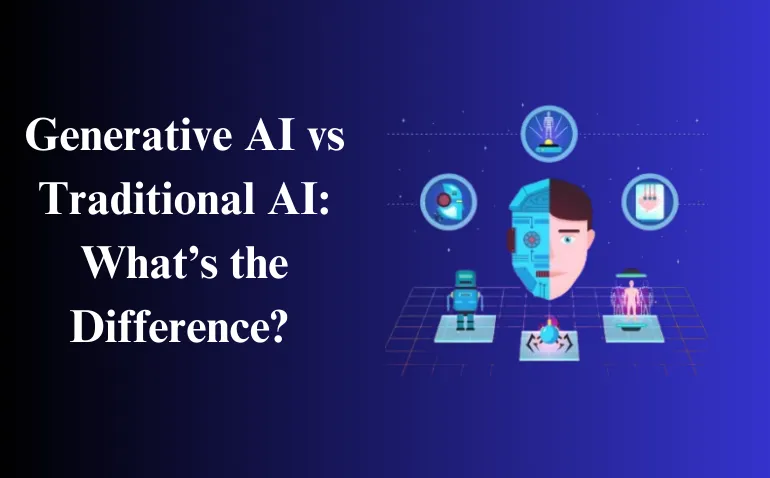
The difference between Traditional AI and Generative AI lies in their purpose and output.
- Traditional AI is analytical, rule-based, and task-specific, excelling in prediction and decision-making
- Generative AI is creative, flexible, and innovative, capable of producing entirely new and human-like outputs
Both are vital to the AI ecosystem, and together they are redefining how humans and machines interact, create, and solve problems.
As industries adopt AI, the real potential lies not in choosing one type over the other but in harnessing the strengths of both to create transformative solutions that improve efficiency, creativity, and human experiences.